
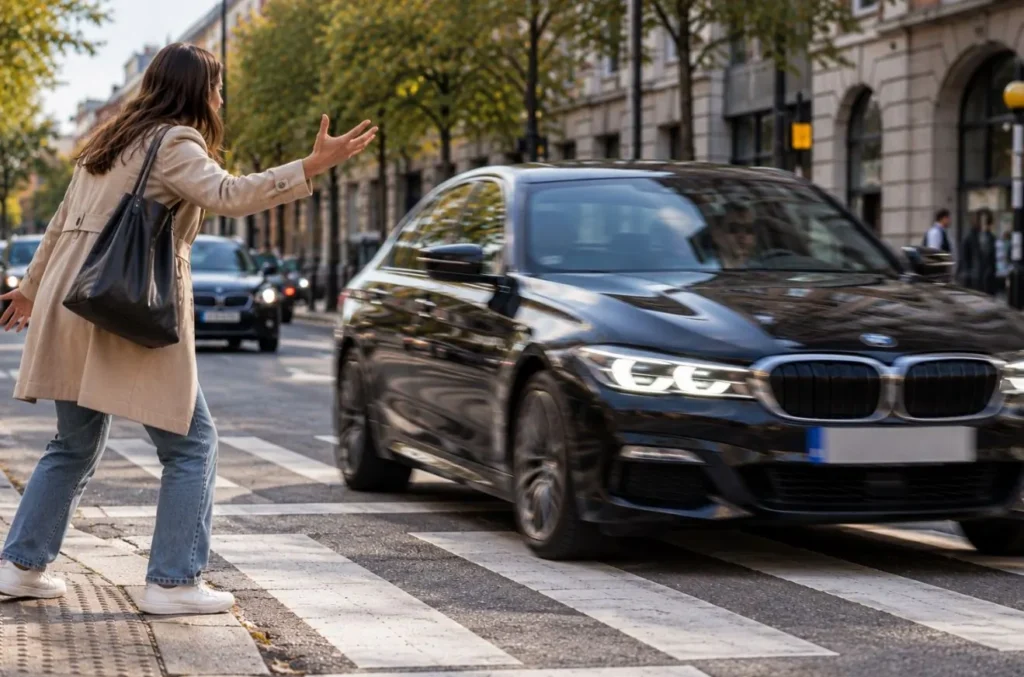
A luxury car can signal wealth, success, and social status. But could the vehicle someone drives also influence how they behave behind the wheel?
Research into driver behavior has uncovered a troubling pattern: motorists driving more expensive vehicles have been found to yield less frequently to pedestrians. Other experiments suggest that the perceived status of a car can influence how other drivers respond to it, including their willingness to honk.
These findings raise an important question: Does the car someone drives affect their behavior, or does the way people perceive wealth influence how they treat others on the road?
The research does not establish that every luxury car owner drives aggressively. However, it highlights a possible relationship between perceived social status and everyday driving decisions that deserves closer attention.
The Study That Examined Car Prices and Pedestrian Safety
In 2020, researchers associated with the University of Nevada, Las Vegas, published a study examining whether the estimated value of a vehicle could help predict whether its driver would yield to a pedestrian.
The study, published in the Journal of Transport & Health, analyzed observations involving 461 vehicles at two midblock crosswalks in the Las Vegas metropolitan area.
Researchers recorded whether motorists yielded to pedestrians and estimated vehicle values using pricing information. They then examined whether car prices were associated with differences in yielding behavior.
The results were concerning. Only 27.98% of the observed vehicles yielded to pedestrians. More importantly, the estimated cost of a vehicle was significantly associated with whether its driver stopped.
The researchers reported that the odds of yielding decreased by approximately 3% for every $1,000 increase in estimated vehicle value.
This does not mean that every $1,000 increase makes a driver exactly 3% less likely to stop in every situation. The figure describes the statistical association observed in the study, not a universal rule about individual motorists.
Nevertheless, the findings suggest that vehicle value may be one factor associated with pedestrian safety.
Why Might Drivers of Expensive Cars Yield Less Often?
The study identified an association, not a definitive explanation for it. Researchers could not determine why individual drivers chose not to stop.
Several possible explanations are worth considering, but they should not be confused with proven causes.
1. Social Status and a Sense of Entitlement
One possibility is that perceived social status influences how people approach situations involving other road users.
Earlier psychological research has examined the relationship between social class and unethical behavior. In a series of studies published in 2012, researchers reported that people perceived as belonging to a higher social class were more likely to engage in certain self-serving behaviors, including cutting off other drivers and failing to yield to pedestrians.
These findings provide context for the car-value research, although they do not prove that wealth itself causes dangerous driving.
It is also important to distinguish a person’s actual income from the status other people associate with their vehicle. An expensive car does not necessarily reveal its owner’s financial circumstances, personality, or values.
2. Different Expectations on the Road
Drivers may respond differently depending on how they perceive other motorists.
Previous experiments have investigated how the status of a vehicle influences reactions to a driver who remains stopped after a traffic signal turns green. Such research suggests that motorists may respond less aggressively to a high-status vehicle than to a lower-status one in certain situations.
This raises an interesting possibility: road interactions may not always be governed solely by traffic conditions. Expectations about the other driver could also influence decisions.
However, these experiments examine particular circumstances and should not be interpreted as proof that every driver treats luxury vehicles more favorably.
3. Time Pressure and Driving Conditions
Not every failure to yield is intentional. Drivers may be distracted, may not notice a pedestrian, or may be uncertain about when they must stop.
Traffic density, visibility, road design, and the timing of a pedestrian’s crossing can also affect driving decisions.
Because the Las Vegas study was observational, it could not establish the motivation behind each driver’s actions. Further research would be needed to separate deliberate rule-breaking from other explanations.
Why Do Drivers Sometimes Hesitate to Honk at Luxury Cars?
Pedestrian yielding is only one part of the broader relationship between vehicle status and road behavior.
Research on driver aggression has also explored whether motorists react differently when another vehicle is perceived as prestigious.
In classic experiments, researchers examined what happened when a vehicle remained stopped after a traffic light turned green. The vehicle’s apparent status influenced how quickly following motorists honked.
Related research has investigated how drivers respond to a slow-moving vehicle, finding that passing behavior can differ depending on whether the vehicle is perceived as high-status or low-status.
These findings suggest that a car’s appearance may influence the social dynamics of driving. A motorist might be more hesitant to challenge a vehicle perceived as prestigious, even when the traffic situation is otherwise similar.
However, honking and yielding are different behaviors, studied under different conditions. The available evidence does not establish that drivers universally honk less at expensive cars or that all luxury vehicle owners receive preferential treatment.
What Does This Mean for Pedestrian Safety?
The most important finding is not whether luxury car owners have worse manners. It is that pedestrian safety remains a serious concern regardless of the vehicle involved.
In the Las Vegas study, fewer than three in ten observed vehicles yielded to pedestrians. That result highlights a broader problem with driver compliance at crosswalks.
Failing to yield can expose pedestrians to serious injury. Even relatively low-speed collisions can have devastating consequences, particularly for children, older adults, and people with limited mobility.
Drivers should remain attentive, understand local right-of-way laws, and yield when required. Pedestrians should also take care to confirm that approaching traffic has stopped before crossing.
Road safety depends on predictable, responsible behavior from everyone, not on the price or prestige of a vehicle.
Do Luxury Cars Make People More Selfish?
It would be misleading to conclude that buying an expensive car makes someone selfish, aggressive, or inconsiderate.
The research shows associations between vehicle status and certain driving behaviors. It does not prove that the car itself changes a person’s character.
Several factors could contribute to the observed patterns, including personality, social expectations, driving habits, and the circumstances in which an interaction occurs.
There is also an important distinction between correlation and causation. A statistical relationship between vehicle value and yielding behavior cannot, on its own, reveal why that relationship exists.
More studies across different cities, road types, and populations could help establish whether these patterns are consistent and identify the factors responsible.
The Bigger Picture: Status Should Never Override Road Rules
Cars are more than a means of transportation. They can communicate identity, lifestyle, and perceived social standing. Research suggests that these signals may influence some interactions between drivers and pedestrians.
But road safety should never depend on what someone drives or how wealthy they appear.
A pedestrian deserves the same consideration whether the approaching vehicle is an inexpensive used car or a brand-new luxury sedan. Likewise, every driver should be treated fairly, without assumptions about their personality based on their vehicle.
The research offers a valuable reminder that everyday decisions behind the wheel can reflect more than traffic conditions alone. Understanding those influences may help researchers and road-safety professionals develop better ways to encourage responsible driving.
Ultimately, the real measure of a driver should not be the price of their car, but how safely and respectfully they share the road.
Sources and Further Reading
- Coughenour, C., et al. (2020). Estimated car cost as a predictor of driver yielding behaviors for pedestrians. Journal of Transport & Health, 16, 100831. Read the research paper.
- Piff, P. K., et al. (2012). Higher social class predicts increased unethical behavior. Proceedings of the National Academy of Sciences. Read the research.
- Guéguen, N., et al. (2014). Car status as an inhibitor of passing responses to a low-speed frustrator. Transportation Research Part F: Traffic Psychology and Behaviour. View the study.